INSIGHTS
Third-party risk in M&A: know what you are buying
A practical framework for third-party risk diligence in acquisitions that protects deal value, strengthens underwriting and makes integration work.
The deal looks good. The numbers work. The growth story is compelling. But what has to keep working for that story to become reality?
An acquisition brings a whole network of dependencies with it: cloud platforms, software providers, outsourced operations, data suppliers, AI models and the people who keep them running. You are buying the business and relying on that network to deliver.
I have performed approximately a dozen M&A-related risk diligence assessments during my career, most recently in September 2026. My view is that third-party risk diligence should help answer a fundamental investment question: can the business continue to deliver the value the buyer believes it is acquiring, under the ownership and operating model being proposed?
A profitable service can depend on a contract that requires consent before transfer. A resilient application can rely on recovery capabilities that remain with the seller. An attractive AI product can depend on data rights, model providers or human oversight that do not survive integration in their current form. Each can affect the transaction even when conventional financial diligence supports the purchase price.
The assessment needs to connect those dependencies to revenue, cost, obligations and decisions. That is where the value comes through: a clearer investment case, better information for financing and insurance, and fewer surprises when it is time to integrate.
Planning an acquisition? Juntero Advisory helps buyers uncover technology and third-party risks, assess integration fit, and turn diligence findings into confident deal decisions. From cyber and AI exposure to practical remediation plans, we focus on protecting value and making the acquisition work. Let’s talk about your next transaction.
Why the acquisition changes the risk
There are three connected subjects of diligence: the target's own capabilities; the external parties that support the target; and the exposure created when those capabilities and dependencies enter the buyer's environment.
The target is not simply another vendor being onboarded. The buyer may inherit contracts, operating responsibilities and historical weaknesses, while also changing how systems, data and people interact. A relationship that was tolerable for a standalone company may become materially different after customer data is combined, privileged access is extended or transaction volumes increase.
Carve-outs make this especially visible. The business may appear well controlled because it uses the seller's identity platform, security operations, cloud agreements and recovery arrangements. If those services will be removed, diligence must assess the replacement or transition arrangement as well as today's controls. A transition services agreement (TSA) needs an achievable exit plan, accountable owners and sufficient time and funding.
This is why I would assess three states separately: the target today, the business at closing and during transition, and the intended integrated business. A control that works today receives no automatic credit in a future environment where its owner, coverage or implementation will change.
One framework. Better questions.
NIST CSF 2.0 supplies the cybersecurity outcome structure: Govern, Identify, Protect, Detect, Respond and Recover. Its supply-chain category explicitly addresses diligence before third-party relationships, ongoing assessment and management across the relationship lifecycle. These outcomes provide a useful basis for examining the target's governance and inherited supplier ecosystem. [1]
NIST AI RMF 1.0 adds an AI-specific perspective through Govern, Map, Measure and Manage. It helps structure questions about intended use, performance, harm and accountability. The Generative AI Profile provides additional guidance where generative models are involved. Neither should be reduced to a check that an AI policy exists. [2, 3]
For cloud services, I use NIST SP 800-144 as foundational outsourcing guidance and the Cloud Security Alliance's Cloud Controls Matrix (CCM) for more detailed cloud control assessment. CCM v4.1 and its companion questionnaire support examination of provider and customer responsibilities. The CCM is a CSA framework, not a NIST publication. [4, 5]
These sources play different roles. They inform the evidence and control expectations; they do not prescribe the M&A scoring model described below. That model adapts my domain-aligned assessment architecture: classification first, inherent exposure second, applicable controls third and residual risk fourth. The broader transaction domains are an M&A extension, while AI use cases retain their specific risk taxonomy and safeguards.
Start with the deal thesis and dependency map
Before issuing evidence requests, establish what must remain true for the acquisition to succeed. Which services generate material revenue? Which customer commitments cannot be interrupted? Which assets or capabilities justify the valuation? What must change at closing, and what can remain separate?
Map each material business service to its applications, data, infrastructure, providers and critical subcontractors. Reconcile the vendor register against procurement and payment records, application inventories, cloud billing, architecture diagrams and interviews with service owners. An incomplete register should be treated as an evidence gap, especially where teams can purchase SaaS or enable embedded AI independently.
For each dependency, record the business owner, service supported, data handled, access granted, critical locations, contract entity, renewal or termination dates, recovery requirements and available substitutes. Capture change-of-control, assignment, licensing and data-use questions for legal review. Trace important fourth parties where they introduce a common failure point, privileged access or dependence that the direct supplier cannot readily replace.
Spend is only one indicator of importance. A modestly priced identity service can interrupt the entire business. A low-cost model API can support a product central to the acquisition thesis. Scope should follow the consequence of failure and the nature of the relationship.
Scope the risks that matter
My scoping principle is that a control becomes applicable through either the relevant risk tier or an exposure-specific feature. Low aggregate severity does not make privacy questions optional when personal data is processed. Similarly, privileged access, cross-border processing, production write permissions and consequential AI decisions create specific assessment requirements.
For M&A, I would organize the core review around the following domains. The references show where to look for guidance. Transaction-specific questions, including compatibility and integration complexity, extend beyond any one source.
| Domain | What the diligence must establish | Framework anchors |
|---|---|---|
| Governance and accountability | Who owns inherited relationships, exceptions, issues and risk acceptance before and after closing? | CSF Govern; AI RMF Govern |
| Cybersecurity and access | Can compromise reach material systems or the buyer, and are access, vulnerabilities and incident capabilities adequately managed? | CSF Protect, Detect and Respond; CCM |
| Privacy and data governance | What data is processed, where it travels, which rights and obligations apply, and whether intended post-close uses are supported? | CCM data security and privacy; AI RMF Map; SP 800-144 |
| Resilience and service continuity | Can critical services recover within business tolerances, including when an external provider or seller service is unavailable? | CSF Recover; CCM continuity and resilience |
| Cloud architecture and shared responsibility | Who owns each control, and will tenant access, keys, logging and recovery work after closing? | CCM; SP 800-144; CSF |
| Compatibility and technical complexity | Will the target fit the intended operating model, and can its systems and dependencies be separated or integrated within the budget and timeline? | M&A integration overlay; CSF Identify; CCM interoperability and portability |
| AI and automated decision-making | Are the specific models, uses, data, outcomes and autonomous actions sufficiently understood and controlled? | AI RMF; Generative AI Profile |
| Legal, contractual and conduct exposure | Do agreements, permissions and operating practices support the proposed transaction and service model? | CSF Govern; AI RMF Govern and Map; counsel-led review |
| Supply-chain concentration and substitutability | Which providers and fourth parties create common dependencies, lock-in, viability concerns or difficult exits? | CSF supply-chain outcomes; CCM; AI RMF Map |
AI still needs its own detailed view. Within that workstream, retain distinct assessments of validity and performance; safety; security and resilience; governance and transparency; explainability and contestability; privacy; fairness and rights; autonomy; legal and conduct exposure; and third-party concentration. A favorable AI security result must not conceal an unresolved fairness or autonomy risk.
Assign each finding a primary risk record, with linked domains where necessary. Reuse evidence across frameworks, but avoid counting the same control several times within a domain simply because it maps to several standards. Likewise, identify shared causes before treating multiple findings as independent exposures.
A domain marked not applicable needs a documented factual basis and reviewer approval. Unknown is not the same as not applicable. Unresolved scope questions stay visible and can prevent the team from reaching a decision.
Will it fit? How hard will it be?
Compatibility and technical complexity deserve an explicit assessment. A target can be secure, profitable and well managed, yet still be expensive or difficult to integrate. That gap can change the economics of the deal.
Compatibility asks whether the target fits the operating model the buyer intends to use. Examine identity platforms, cloud environments, application interfaces, data formats, security requirements and service-management practices. Include vendor terms and licenses that may prevent consolidation. If the plan is to operate separately, assess the interfaces that still need to work: reporting, oversight, customer commitments and shared services.
Technical complexity asks how difficult the change will be. Look for tightly coupled applications, custom integrations, unsupported technology, undocumented dependencies, specialist skills and seller-owned services that cannot be easily separated. Count the critical handoffs, then test what could fail at each one. A large system inventory alone does not tell you how hard the integration will be.
Ask for architecture and data-flow diagrams, interface inventories, version and support information, sample migration results, resource estimates and a staged cutover plan with rollback. Test the assumptions with the people who will do the work. “We will migrate it after closing” is a project idea, not an integration plan.
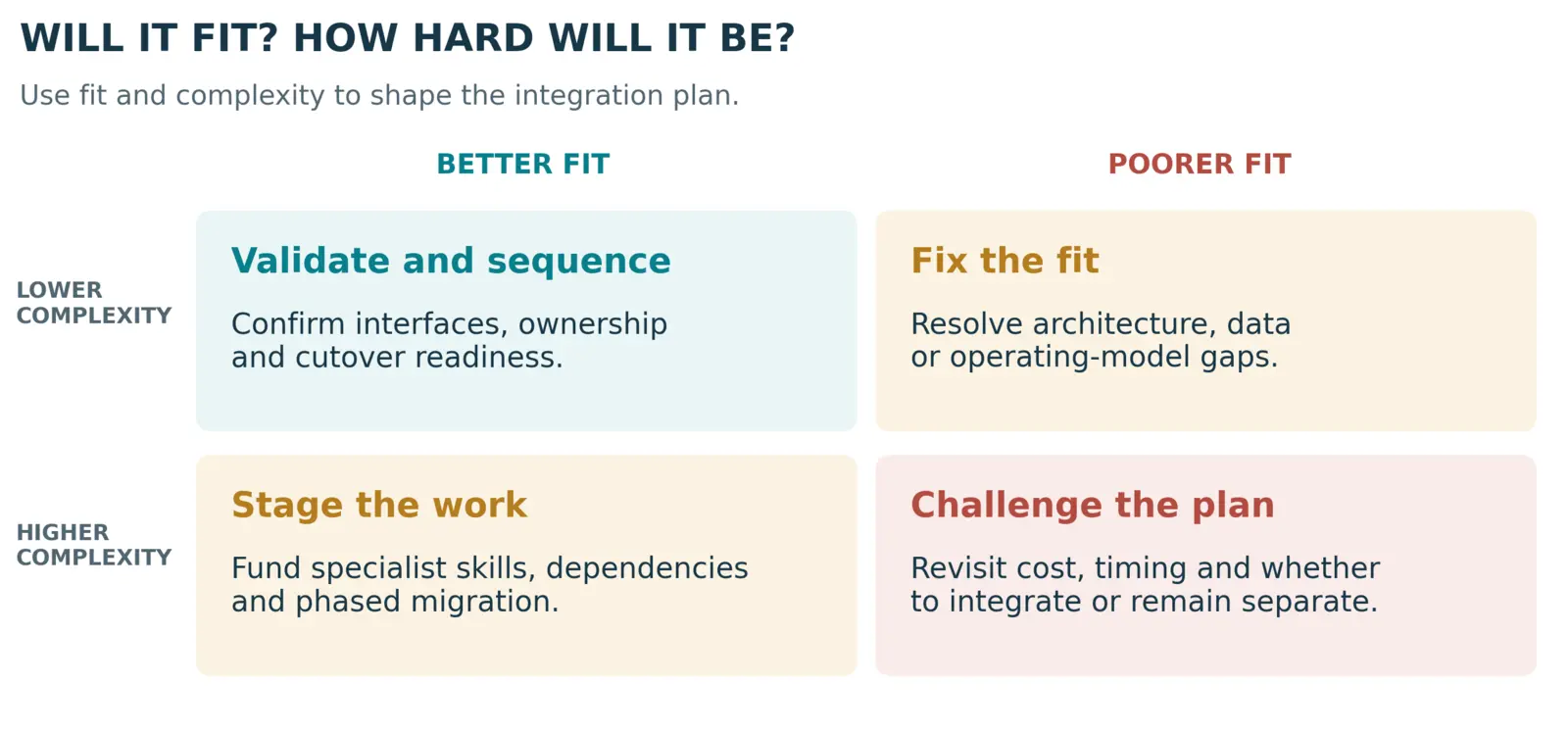
Keep the scoring honest. Compatibility gaps create scenarios such as failed migration, lost functionality or delayed synergies. Complexity can increase their likelihood and consequence; it is also a driver in other domains. Record the integration exposure here, link its cyber or resilience effects, and avoid counting the same cost or loss twice. Poor fit is inherent exposure; a tested migration and rollback plan is a mitigating control.
Keep classification, inherent risk and control strength separate
Stage A establishes the transaction boundary, use-case classification and mandatory treatment. Legal or policy restrictions, regulated decisions, safety-critical applications and required contractual permissions must be identified before scoring. A low score cannot authorize an impermissible activity. Counsel should determine the legal implications of transaction-specific rights and obligations.
Stage B assesses inherent exposure for each applicable domain, assuming no use-case-specific safeguards. Likelihood and impact are each scored from 1 to 5. Likelihood should reflect factors such as exposure frequency, users affected, complexity, data uncertainty, external dependency and the ability of failures to propagate. Existing controls are evaluated later.
Impact uses the highest credible consequence across the applicable dimensions, rather than an average. My full model considers harm to people, physical safety, financial or valuation loss, market integrity, operational disruption, legal exposure, privacy, cybersecurity, customers, reputation, environmental impact and strategic or intellectual-property loss. Where three or more dimensions independently score 4 or above, impact increases by one level, capped at 5.
For transaction use, financial and operational anchors should be agreed before scoring: for example, which services and outage durations threaten the deal thesis, and what level of unplanned cost is material to the investment. The same event may have different significance to the target and the buyer; both perspectives should remain explicit.
The domain score is likelihood multiplied by impact. The established bands are 1–4 Minimal, 5–9 Low, 10–14 Moderate, 15–19 High and 20–25 Critical. Overall inherent risk follows the highest domain score. Where three or more domains independently rate High or above, the overall rating increases one level, capped at Critical. These are prioritization conventions, not statistical estimates of loss probability.
Preserve applicable classification floors and diagnostic floors. For example, an AI system capable of transferring value without transaction-level human approval warrants different treatment from an informational assistant. A non-AI transaction condition should not receive an invented numerical floor simply to make the model symmetrical; any extension requires an explicit rationale and approval.
Evaluate only the controls that mitigate the domain
Stage C tests control design, implementation and operation. Evidence should show what the control covers, who performs it, when it operated and what happened when an exception occurred. Policies and management assertions help explain the process; they do not independently demonstrate that it works.
For live services, examine operating evidence: access reviews, configuration exports, recovery results, incident records, remediation tickets and relevant assurance reports. Check report dates, systems covered, exclusions, exceptions and customer responsibilities. Provider assurance does not establish that the target has fulfilled its own obligations.
For planned integration controls, distinguish design and pre-production validation from actual operating effectiveness. A future intention to adopt the buyer's controls cannot reduce the target's current residual risk. Show the expected future position separately, with the conditions and evidence required to achieve it.
My domain-aligned aggregation assigns applicable mapped controls a score of 1 for Weak/Ineffective, 2 for Partially Effective, 3 for Effective and 4 for Strong. The equal-weighted domain average becomes Strong at 3.5 or above, Effective at 2.5 or above, Partially Effective at 1.5 or above, and Weak/Ineffective below 1.5.
There is an essential safeguard: if any applicable mapped control is Weak/Ineffective, the domain rating is capped at Partially Effective. If no controls are confirmed as applicable to an in-scope domain, effectiveness defaults to Weak/Ineffective. A genuinely out-of-scope domain remains excluded with its rationale.
This prevents strong but unrelated controls from offsetting a material weakness. Encryption may mitigate confidentiality exposure; it does not establish recovery capability or the right to transfer a license. Cross-cutting readiness requirements should be assessed as explicit gates, rather than added to every domain average to improve the score.
Keep the score honest
Stage D combines each domain's inherent rating with its own control-effectiveness rating using a qualitative matrix. It does not calculate residual risk by multiplying inherent risk by an assumed percentage reduction.
| Inherent rating | Strong controls | Effective controls | Partially effective | Weak/ineffective |
|---|---|---|---|---|
| Critical | High | High | Critical | Critical |
| High | Moderate | Moderate/High | High | High |
| Moderate | Low | Low/Moderate | Moderate | Moderate/High |
| Low | Low | Low | Low | Moderate |
| Minimal | Minimal | Minimal | Low | Low |
This preserves the established matrix, including its dual-rating cells. For this M&A application, I recommend a documented calibration convention: use the higher outcome unless a reviewer records a defensible rationale for the lower one and the designated authority approves it. That convention is a transaction-specific addition, not a NIST or CSA rule.
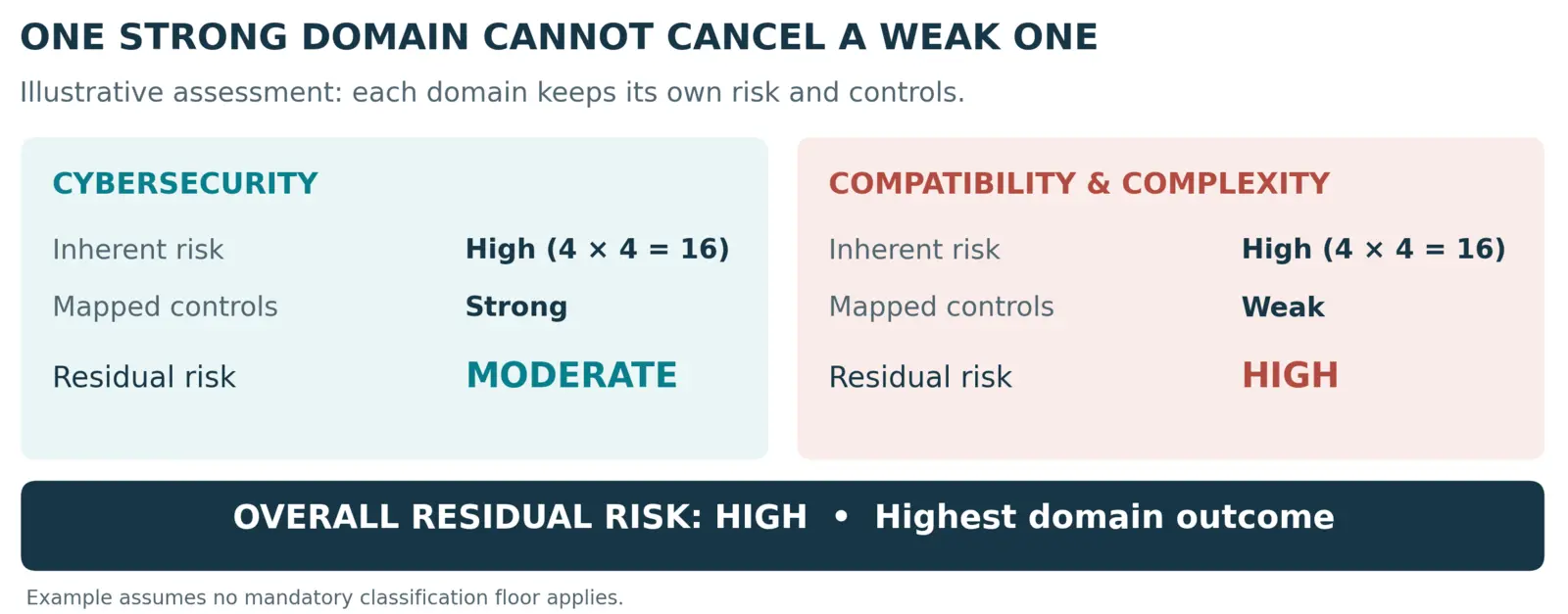
Overall residual risk follows the highest applicable domain residual rating, subject to mandatory classification floors that also constrain residual treatment. A Critical inherent exposure cannot fall below High solely because controls are strong; an applicable floor may require an even higher outcome. Approval authority follows inherent exposure, while residual risk determines whether formal risk acceptance is required.
Keep evidence confidence separate from the risk rating. Record coverage limitations, information age, untested claims and unresolved requests. Missing evidence does not prove that a failure exists, but it cannot justify credit for an unverified control or an unqualified conclusion.
Cloud and AI require particular attention
For cloud, test the target's actual deployment. Who controls the tenant, root accounts, encryption keys and billing relationship? Which accounts belong to the seller? Are privileged identities separable? Can logs and backups remain available after closing? Have recovery arrangements been exercised for the workloads the buyer will operate? Can data be returned in a usable format within the proposed exit timetable?
Map responsibility control by control across the cloud provider, target, managed service provider and buyer. A responsibility table becomes useful when each assignment is supported by evidence and a named owner. Pay particular attention to changes during migration, when old controls may be removed before replacement controls are operating.
For AI, start with the use case and include embedded AI in ordinary SaaS products. Identify foundation models, retrieval sources, training or fine-tuning data, agents, tools and human decision points. Examine permitted data uses, provider retention, model changes, evaluation results, incident handling and replacement options.
Where agents can take action, assess their authority: tools available, production access, transaction limits, approval checkpoints, auditability and the ability to stop or reverse actions. If AI functionality is central to the valuation, examine whether demonstrated performance survives the buyer's intended users, data and workflows. A successful demonstration is not sufficient evidence of sustained reliability.
Convert findings into transaction decisions
Consider an illustrative acquisition of a software business whose customer service depends on an external AI provider. Security controls may be Effective, while supplier concentration remains High because an abrupt provider change would interrupt the service and no tested substitute exists. Strong security evidence does not resolve that dependency.
If the service also runs in a seller-owned cloud tenant, the assessment must distinguish current control strength from closing readiness. The buyer may be able to acquire the business while delaying technical integration, subject to an enforceable and operationally credible transition arrangement. Alternatively, unresolved permissions or continuity gaps may require changes before closing.
Each material finding should therefore state the affected service, domain, scenario, evidence, residual rating and transaction consequence. It should also identify the required action, accountable owner, target date, validation method and decision authority. Classify the response clearly: resolve before signing or closing; restrict integration; fund post-close remediation; formally accept exposure; restructure the transaction; or reconsider the investment.
Translate remediation into commercial terms with finance and the deal team. Estimate one-time separation or migration costs, recurring run-rate changes, transition-service extensions and potential delays to expected synergies. Use ranges and state assumptions. A risk score is not a dollar valuation, and adding overlapping loss scenarios can exaggerate exposure.
Make the diligence useful to lenders and insurers
This work becomes even more valuable when it reaches the people underwriting the transaction. The buyer, lender and insurer are looking at the same business through different lenses. A good diligence pack gives each of them facts they can use.
For financing: can the business support the debt?
Credit underwriters assess repayment capacity and downside exposure. The OCC's leveraged-lending handbook connects underwriting to cash flow, enterprise value and stress testing. Third-party diligence can strengthen the assumptions behind that analysis by showing where revenue could stop, costs could rise or integration benefits could arrive late. [6]
Translate the findings into a base case and a credible downside case with finance. Include recurring vendor-cost increases, one-time migration spending, extra working capital, delayed savings and the cost of keeping seller services running. Show when the cash is needed and how the buyer will fund it. Separate effects on earnings from effects on cash, and use the lender's own debt-service definitions.
For example, a licensing restriction may require two systems to run in parallel for another year. That changes the savings timetable and the cash available to repay debt. The useful output is an updated forecast with evidence, not simply an “integration risk: High” label.
This can help a lender assess debt capacity, liquidity needs, covenant headroom and conditions to funding. It also gives the buyer a stronger basis for challenging an optimistic valuation. The benefit is a more defensible financing case; it does not guarantee approval or a lower interest rate.
For insurance: which losses can be transferred, and on what terms?
Insurance underwriters assess the exposure they may cover, the controls in place and the terms needed to write that risk. Marsh's M&A guidance links cyber diligence to financial exposure, existing coverage and an insurance action plan around completion. [7]
Give the broker and underwriter a clear view of critical providers, sensitive data, access controls, recovery testing, incidents and planned integration changes. For cloud or outsourced-service outages, ask whether the proposed cover responds to the business's actual dependency, including relevant system-failure or dependent-business-interruption triggers. Coverage depends on the wording, limits, sublimits, waiting periods and exclusions. [8]
Bring representations and warranties insurance into the discussion where it is part of the transaction. It addresses covered losses arising from breaches of specified seller representations and warranties. It is not interchangeable with cyber insurance or a promise to pay for planned integration work. [9]
Ask the insurance team to resolve transaction-specific questions before closing: which entity is insured, what happens on a change of control, how prior acts or known issues are treated, what notifications are needed, and whether a transition or run-off arrangement is required. Diligence findings should be disclosed accurately and matched to the proposed cover.
Better evidence can support a more informed discussion of coverage, pricing, limits, retentions and exclusions. It may also reveal an exposure the insurer will not take. That is useful information while the buyer can still change the terms, fund remediation or retain the risk deliberately.
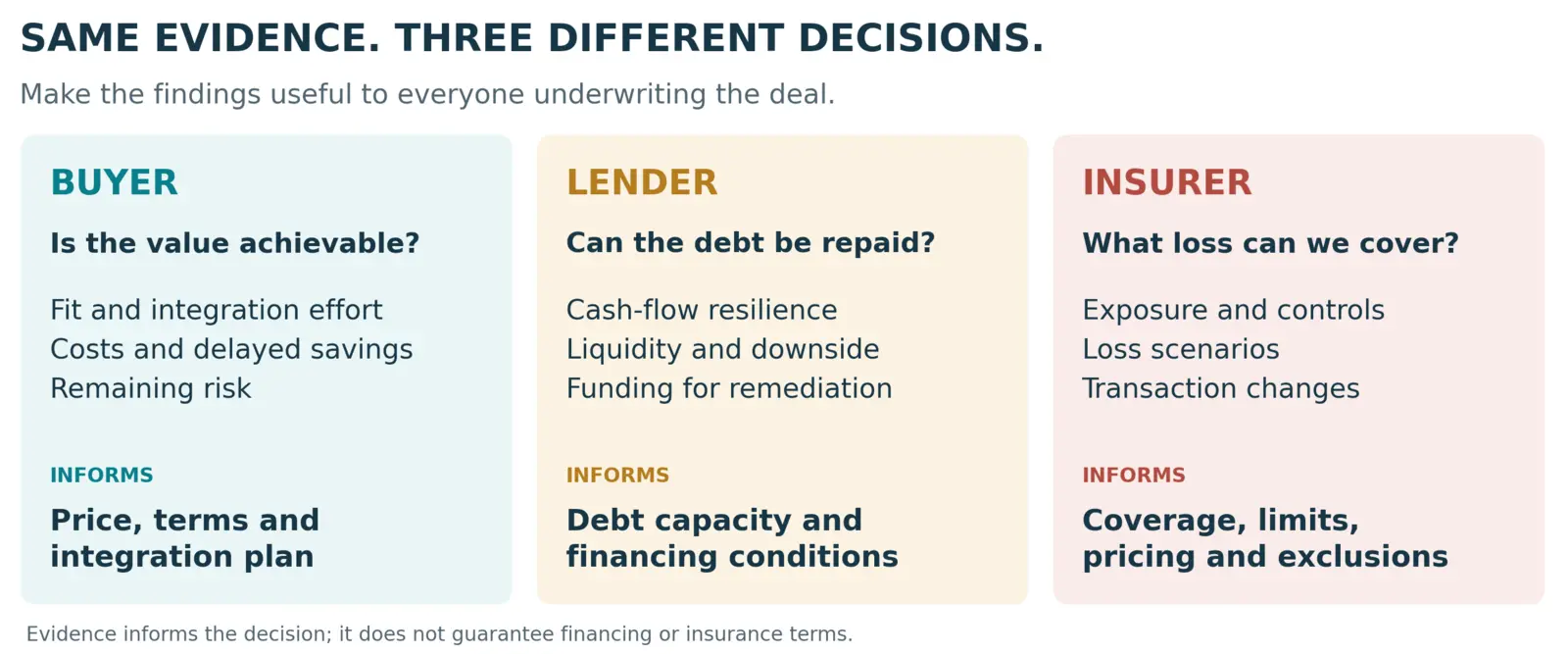
The handoff should be simple: the material findings, the evidence behind them, their financial consequences, the remediation budget and the open decisions. Lenders and insurers make their own underwriting judgments. Our job is to make sure those judgments start with a clear picture of the business.
Separate the acquisition decision from permission to integrate
A defensible assessment distinguishes transaction approval, Day 1 service readiness and technical integration readiness. Passing one does not automatically satisfy the others. The buyer may accept ownership while prohibiting connectivity to sensitive environments until access, monitoring or recovery conditions are met.
For AI, preserve the separate launch and sustained-operation gates. Pre-production evidence supports a launch decision; subsequent operating evidence supports continued use. Closing the deal does not reset an inherited AI system's history or create operating evidence for a changed deployment.
The diligence record should become the integration work plan. Reassess when data scope, access, architecture, providers, autonomy or business use changes. Confirm that promised controls are implemented and effective before lowering residual ratings. Escalate missed conditions to the authority that accepted the risk, rather than allowing them to become indefinite project reminders.
The real value of third-party diligence
Good third-party risk diligence makes the dependencies behind a transaction visible and actionable. It clarifies what the buyer is relying on, which assumptions are supported, what must change and who will own the remaining exposure.
The frameworks help us ask better questions. Domain-aligned scoping keeps the work focused. Domain-aligned scoring connects each risk to the controls that actually address it. Compatibility and complexity show what it will take to make the acquisition work. Together, they give buyers, lenders and insurers a clearer basis for their decisions.
An acquisition is a commitment to operate what you have purchased. Know the dependencies. Test the fit. Price the work. Then move forward with a plan the deal team can stand behind.
Sources and framework references
- NIST, The Cybersecurity Framework (CSF) 2.0, February 2024.
- NIST, Artificial Intelligence Risk Management Framework (AI RMF 1.0), January 2023.
- NIST, Artificial Intelligence Risk Management Framework: Generative Artificial Intelligence Profile, July 2024.
- NIST, SP 800-144: Guidelines on Security and Privacy in Public Cloud Computing, December 2011.
- Cloud Security Alliance, Cloud Controls Matrix and CAIQ v4.1.
- Office of the Comptroller of the Currency, Comptroller’s Handbook: Leveraged Lending.
- Marsh, Cyber Due Diligence Services for Private Equity M&A.
- Marsh, CrowdStrike Outage Event: Coverage and Recovery Resource Guide, July 2024.
- Aon, Representations and Warranties Insurance.
The scoping, scoring, aggregation and decision rules in this article reflect the author's methodology and its proposed M&A application. The referenced frameworks inform assessment coverage; they do not confer certification or endorsement of the methodology.