INSIGHTS
Resilience mapping: know what your services depend on
A practical approach to resilience mapping that finds the weak points before an outage does and shows the business can stay within tolerance.
The service runs every day. Customers rarely think about it. Then it stops. What did it depend on that nobody had written down?
Every important service rests on a network of dependencies: people with specialist knowledge, processes that pass work between teams, applications and infrastructure, offices and data centres, the information that flows between them, and the providers who run more of it every year. You deliver the service, and you rely on that network to let you.
I have spent much of my career on that question, from supporting business continuity and disaster recovery at JPMorgan Chase during Hurricane Sandy to directing vendor resiliency, business continuity and recovery assurance as head of vendor risk management at Bloomberg. My view is that resilience mapping should answer one operational question: can this service stay within the level of disruption the business has decided it can tolerate, and if not, where exactly will it break?
A payments service can depend on one processor that five of its six processes need. A recovery plan can assume a failover that has never been exercised for the workload that matters. A settlement process can depend on one specialist with no deputy. Each can push a service beyond tolerance even when every individual control looks sound.
The map needs to connect those dependencies to outcomes, tolerances and decisions. That is where the value comes through: fewer surprises in an incident, a self-assessment the board can stand behind, and remediation spending directed where it changes the result.
Preparing for a resilience review? Juntero Advisory helps firms map their important services, find the single points of failure and concentrations that matter, and turn the results into tested, board-ready decisions. From third-party dependencies to scenario testing, we focus on keeping services running when something fails. Let’s talk about your important services.
Why mapping became an expectation
Operational resilience used to sit with business continuity: plans, recovery time objectives and an annual exercise. Regulators have moved the question. They now ask whether the services customers and markets depend on can continue through severe but plausible disruption, and they expect firms to show their working.
The expectations have converged. The Basel Committee's Principles for Operational Resilience ask banks to map the interconnections and interdependencies behind their critical operations. In the UK, the PRA and FCA require firms to identify important business services, set impact tolerances and map the resources that deliver them; the transition period ended on 31 March 2025. [1, 2, 3]
The EU's Digital Operational Resilience Act (DORA) has applied since January 2025 and requires financial entities to identify and document ICT-supported business functions, map their information and ICT assets, and identify the third-party providers that support critical or important functions. APRA's CPS 230 commenced in Australia on 1 July 2025 with comparable expectations for critical operations. US agencies set out the same direction in their 2020 sound-practices paper. [4, 5, 6]
The language differs. The core does not: identify what matters, decide how much disruption is tolerable, map what the service depends on, test it against severe but plausible scenarios, and fix what fails.
Mapping is the step that makes the rest possible. It is also the step most programs struggle with. Maps take months to build, go stale within a year, miss third parties and stop at a diagram instead of telling anyone where the risk is.
Different words. The same questions.
For firms operating across jurisdictions, the vocabulary alone can fragment the work. I keep the method in plain terms and translate the outputs into each regulator's language. The table shows what the map must establish for each element and where to look for guidance.
| Element | What the map must establish | Regulatory anchors |
|---|---|---|
| Service | Which outcomes would cause intolerable harm to customers, markets or the firm if they were disrupted? | PRA/FCA important business services; DORA critical or important functions; CPS 230 critical operations; Basel and US critical operations |
| Tolerance | How much disruption, data loss and service degradation can each service absorb, and on what rationale? | PRA/FCA impact tolerances; CPS 230 tolerance levels; US tolerance for disruption; DORA recovery objectives |
| Resources | Which people, processes, technology, facilities and information does each service need in order to function? | PRA mapping expectations; Basel Principle 4; DORA Article 8; CPS 230 |
| Third parties | Which providers, and which of their providers, does the service rely on, and can they be replaced? | PRA mapping expectations; DORA Article 8; CPS 230 service providers; Basel Principle 5 |
| Testing | Can the service stay within tolerance under severe but plausible scenarios, with evidence rather than assertion? | PRA/FCA scenario testing; CPS 230 business continuity testing; Basel Principle 3 |
| Governance | Who owns the results, approves tolerances and accepts the remaining exposure? | PRA/FCA board-approved self-assessment; CPS 230 Board-approved tolerance levels; Basel Principle 1 |
| Maintenance | Does the map stay current as the business, its systems and its suppliers change? | PRA annual update or after significant change; DORA inventories updated on major change |
These sources play different roles. They set expectations and minimum standards; they do not prescribe the mapping method or the rules described below. That method adapts the same discipline I apply to AI risk: agents draft, fixed rules compute and people decide.
Start with the service and its tolerance
Before mapping anything, decide what you are mapping for. Which services, if disrupted, would cause intolerable harm to customers, threaten market integrity or put the firm's viability at risk? Start from the customer or market outcome, not from the organization chart or the application inventory.
Be careful with shortcuts. The FCA has observed some firms excluding services because a competitor could step in. Substitutability is one factor, not a reason on its own. Document why each service is in scope, and why others are not. [3]
Then set the tolerance. Most firms express it as time, and time matters. But a tolerance becomes useful when it also reflects who is affected and how badly: the number of customers unable to transact, the value of payments delayed, the data that cannot be lost and the minimum service the business will maintain while it recovers. The FCA has noted a wide range of tolerances with limited rationale for where intolerable harm begins. Write the rationale down. [3]
A tolerance is not a recovery time objective. A recovery objective describes what a system is designed to achieve; the tolerance describes the point at which harm becomes unacceptable. Recovery objectives should sit comfortably inside it. If they do not, that is already a finding. [3]
Map only what can stop the service
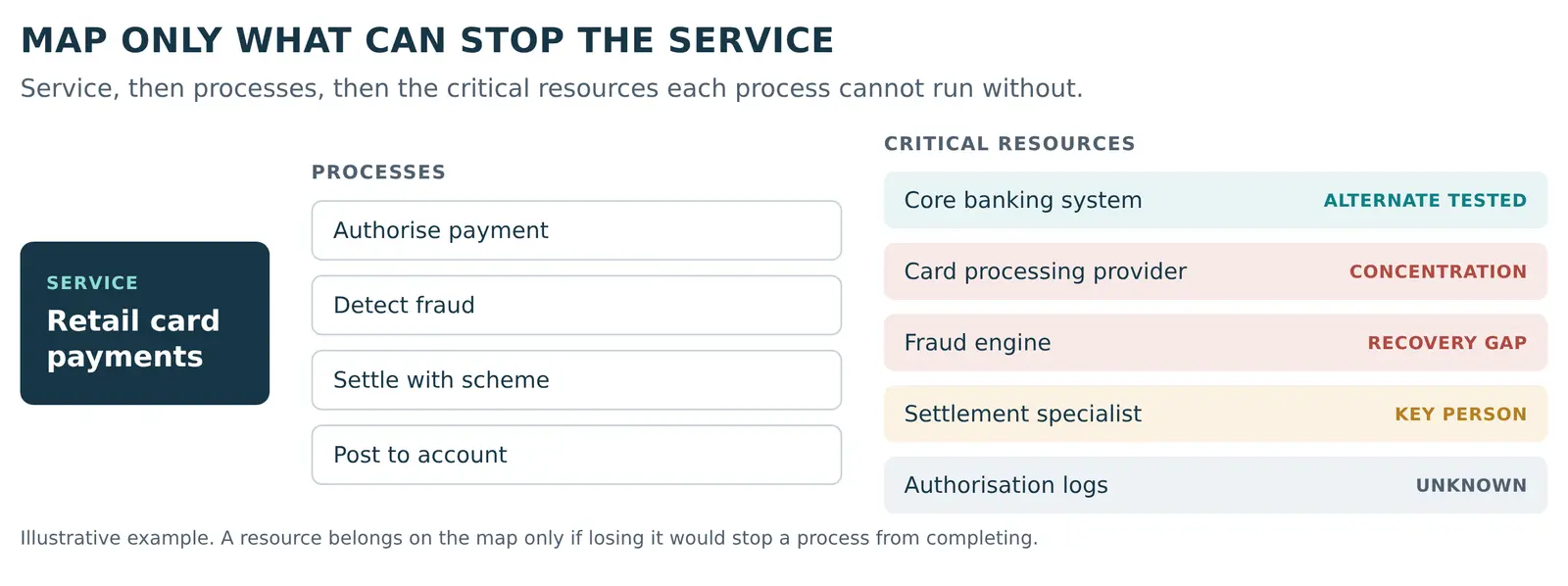
My mapping principle is simple: a resource belongs on the map if losing it would stop a process from completing. Resources that only make the work slower or less efficient add noise. The PRA expects firms to map to the level of detail necessary to identify vulnerabilities and test against tolerance. More detail than that is cost, not insight. [2]
Use two tiers. Map each service to the processes that deliver it, then map each process to the critical resources it needs: people, technology, facilities, information and the third parties that provide any of them. Keep each service to around ten processes. If you cannot explain the chain to a new colleague or a regulator in about a minute, the map is too detailed to use. [7]
Build the first draft from evidence the firm already has: process documentation, the business impact analysis, system and asset inventories, the vendor register, architecture diagrams, cloud billing and payment records. Then check it in both directions. Top-down, service owners confirm how the service actually works today. Bottom-up, resource owners confirm what depends on their system, site or team. Each direction finds what the other misses.
For each critical resource, record the owner, the processes it supports, its alternate or workaround, its recovery time and recovery point, its location and any third party involved. Unknown is not the same as no. A missing recovery time is an open question, and it stays visible until someone answers it.
Find the weak points with rules, not opinion
Once the map exists, the analysis should be repeatable. I use a small set of fixed rules and let the map do the counting. Each finding records the rule that produced it, so a reviewer can see exactly why it was flagged.
| Rule | What it flags | Typical response |
|---|---|---|
| No alternate | A critical resource with no backup, substitute or tested workaround | Build or test an alternate; document a manual workaround |
| Shared resource | One resource supports three or more of the service's processes | Confirm and test its recovery; separate where practical |
| Concentration | Three or more processes depend on the same provider, site or cloud region | Test the provider scenario; assess substitutability and exit |
| Key person | A person or small team the service needs, with no trained deputy | Train a deputy; write and rehearse the runbook |
| Recovery gap | Recovery time or data loss exceeds the service's tolerance | Fix the design, or accept formally with a dated plan |
| Vendor without an exit | A critical provider with no exit plan or tested continuity arrangement | Obtain evidence; agree exit options or step-in arrangements |
| Unknown | No owner, recovery time or recovery point recorded | Assign an owner and a date to answer |
Thresholds are starting points. A bank with hundreds of processes will set them differently from an insurer with a handful. What matters is that they are agreed before the analysis, applied consistently and documented with each finding.
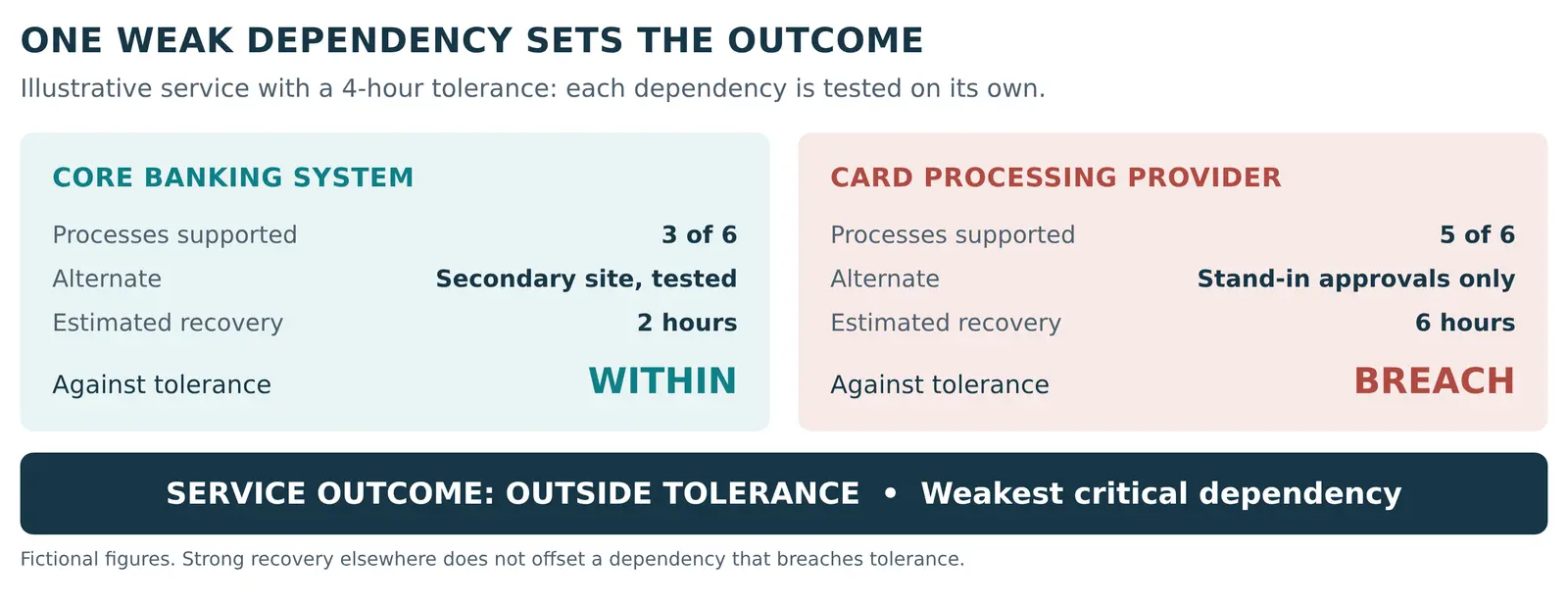
Rules also prevent a common distortion. A service can look resilient because most of its resources are well controlled. But resilience does not average. One critical dependency without an alternate can take the whole service outside tolerance, however strong everything else is.
Test against the tolerance, not against the plan
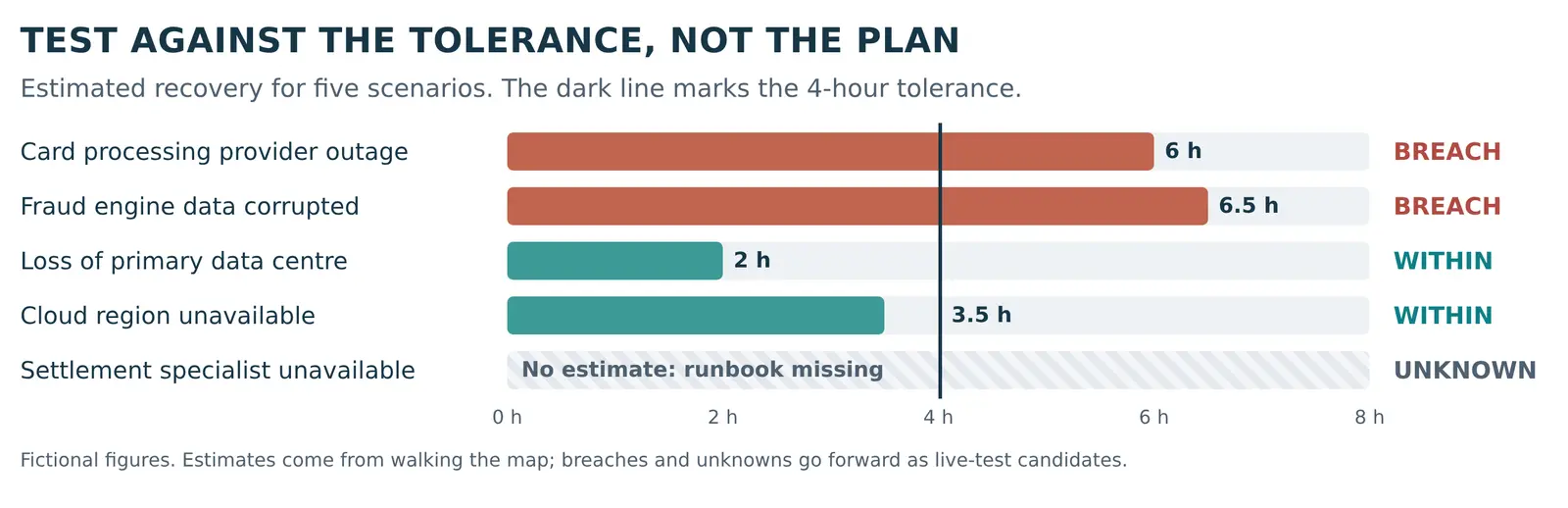
Scenario testing is where the map earns its keep. Aim scenarios at the weak points the rules found: the loss of a concentrated provider, a site or a key team, or the corruption of critical data. Severe but plausible means exactly that: hard enough to stress the service, realistic enough to happen.
Walk each scenario through the map. Which processes stop? What workarounds exist? How long until the service is back, and how much harm accumulates in the meantime? Classify each result as within tolerance, breach or unknown. Unknown is a result, and often the most important one.
Then move from estimates to evidence. The FCA has encouraged firms to move away from judgment-based, desk-based scenario tests toward tests that produce empirical data, such as simulations and failover tests, and to increase severity over time. It also found limited evidence that response plans, not just recovery, had been tested. A plan that has never been exercised is an assumption. [3]
Where a provider runs the critical resource, the test has to reach them. A provider may test its own resilience, but the firm must be satisfied with the method and the results. Accountability for staying within tolerance does not transfer with the contract. [2, 3]
Third parties are inside the map, not beside it
Most services now depend on providers for something critical: cloud infrastructure, core platforms, payment processing, data and, increasingly, AI models. The PRA expects firms to map the resources needed to deliver an important business service irrespective of whether a third party provides them. DORA asks financial entities to identify their interconnections with the ICT third-party providers that support critical or important functions. [2, 4]
Map the provider where it sits in the service, not in a separate vendor list. That is how concentration becomes visible: the same provider, cloud region or data centre appearing under several processes, sometimes under several services. Trace fourth parties where they introduce a common failure point that the direct provider cannot readily replace.
Ask providers for evidence that matches the dependency: recovery test results for the services you actually use, assurance reports with their scope and exceptions, incident history and notification commitments. The PRA notes that firms may ask third parties for their own mapping, but that this is not required in all cases. What matters is that the firm understands the dependency well enough to test it. [2]
Substitutability deserves an honest answer. Could the service move to another provider, an in-house alternative or a manual process within tolerance? If not, the exit plan is not a contract clause. It is a resilience control that needs an owner, a timeline and a test.
Where AI agents help, and where they do not
Mapping is labor-intensive, which is one reason maps go stale. It is a good use for AI agents, within clear limits. In the Resilience Mapping Toolkit I am building at Juntero Labs, agents draft each stage: a service card from existing documents, a first map from process and inventory evidence, owner questions for every gap, scenarios aimed at the findings and a first draft of the self-assessment.
Agents do not decide. Fixed rules compute the findings so that they are consistent and defensible. People approve tolerances, confirm the map, accept or remediate findings and choose which tests to run. Every agent output is a draft with its sources attached, and it remains a draft until an accountable owner signs it off.
AI is also a dependency in its own right. A model provider supporting a customer-facing process belongs on the map like any other critical provider, with its own recovery, change and exit questions.
Convert findings into decisions
Consider an illustrative retail card payments service with a four-hour tolerance. The map shows that five of its six processes depend on one card processing provider. The fraud engine recovers in six hours. Settlement depends on a single specialist. Core banking supports three processes but fails over to a tested secondary site.
Those findings call for different responses. The fraud engine's recovery gap needs a design fix and a date. The provider concentration needs a live test of the stand-in arrangements and an assessment of exit options. The key person needs a deputy and a runbook. The shared core banking dependency may be acceptable, with the rationale recorded and the failover kept under regular test.
Each material finding should therefore state the service, the resource, the rule that flagged it, the evidence, the effect on tolerance and the decision. It should also name the accountable owner, the target date and how the fix will be validated. Classify the response clearly: remediate; test; accept formally; redesign; restrict change or growth until resolved; or exit the dependency.
Translate remediation into cost and time with finance. A resilience gap that needs a second provider, a duplicate site or additional staff is an investment decision. Present it as one, with options, ranges and stated assumptions.
Give the board a self-assessment it can use
In the UK, the governing body must approve and regularly review the firm's self-assessment. The FCA describes strong self-assessments as including an overview of the vulnerabilities found and the scenarios tested, with any concerns about remaining within tolerance clearly documented. CPS 230 likewise makes tolerance levels a matter for Board approval. [3, 5]
Give directors one view per service: the outcome, the tolerance, the critical dependencies, the findings and their decisions, the scenarios tested and the result. Show what has changed since the last review, and why. A board can challenge a clear picture. It cannot challenge a hundred-page appendix.
Keep the map alive
A map is a snapshot. The PRA expects firms to update their mapping at least annually, or sooner following significant change. DORA requires the relevant inventories to be updated periodically and whenever a major change occurs. [2, 4]
Annual review is the floor, not the method. Connect the map to the processes that change it: vendor onboarding and renewal, architecture and change approval, organizational change and incident reviews. When a dependency changes, re-run the analysis and scenarios for the services it supports. Escalate overdue findings to the authority that accepted them, rather than letting them become permanent reminders.
The real value of resilience mapping
Good resilience mapping makes the dependencies behind a service visible and actionable. It shows what the service relies on, where it will break, which assumptions have been tested and who owns the remaining exposure.
The regulations tell us what to establish. Critical-only mapping keeps the work focused. Fixed rules keep the findings honest. Testing against tolerance turns assumptions into evidence. Together, they give the board a clearer basis for its decisions.
A service is a promise the business makes every day. Know what it depends on. Find where it breaks. Fix what matters, then prove it.
Sources and regulatory references
- Basel Committee on Banking Supervision, Principles for Operational Resilience, March 2021.
- Prudential Regulation Authority, SS1/21 Operational resilience: Impact tolerances for important business services, Chapter 5: Mapping.
- Financial Conduct Authority, Operational resilience: insights and observations for firms, May 2024.
- Regulation (EU) 2022/2554 on digital operational resilience for the financial sector (DORA), Article 8: Identification.
- Australian Prudential Regulation Authority, CPS 230 Operational Risk Management: response paper.
- Board of Governors of the Federal Reserve System, OCC and FDIC, Interagency Paper on Sound Practices to Strengthen Operational Resilience, November 2020.
- Protecht, Operational resilience series: mapping important business services.
The mapping principle, rules and decision conventions in this article reflect the author's methodology. The referenced regulations and guidance inform scope and expectations; they do not confer certification or endorsement of the methodology.