PROJECT · In development

Resilience Mapping Toolkit:
see what your services depend on.

A consultant-led toolkit that maps an important service to the people, processes, technology, facilities, information and third parties behind it. It finds the weak points with fixed rules and tests them against how much disruption the business can tolerate. Agents draft each stage; people make every decision.

STATUS

In development: design stage

METHOD

5 stages, 7 fixed rules, a person signs off each stage

ALIGNED TO

UK PRA/FCA, EU DORA, APRA CPS 230, Basel, US interagency

BUILT WITH

A Claude Project with skills; one working file per service

THE PROBLEM

Maps that take months, then go stale.

Every major regime now asks firms to map what their most important services depend on, and to show they can stay within a tolerance for disruption. In practice, maps take months to build, drift within a year, miss third parties, and stop at a diagram instead of saying where the risk is.

Regulators keep finding the same gaps: tolerances with thin rationale, desk-based tests that produce no evidence, and response plans that are never exercised.

THE APPROACH

Map only what matters, then use it.

The toolkit treats mapping as a means to an end: finding vulnerabilities and testing against tolerance. It maps only critical resources, the ones whose loss stops a process, and keeps each service to about ten processes.

It starts from documents a firm already has and asks owners targeted questions about the gaps. And it reuses the rule behind JATCF: agents draft, fixed rules compute, people decide.

HOW IT WORKS

Five stages. A person signs off each one.

Agents do the drafting and the legwork. Rules do the counting. People own every decision.

  1. STAGE 1 · SCOPE

    Define the service and its tolerance

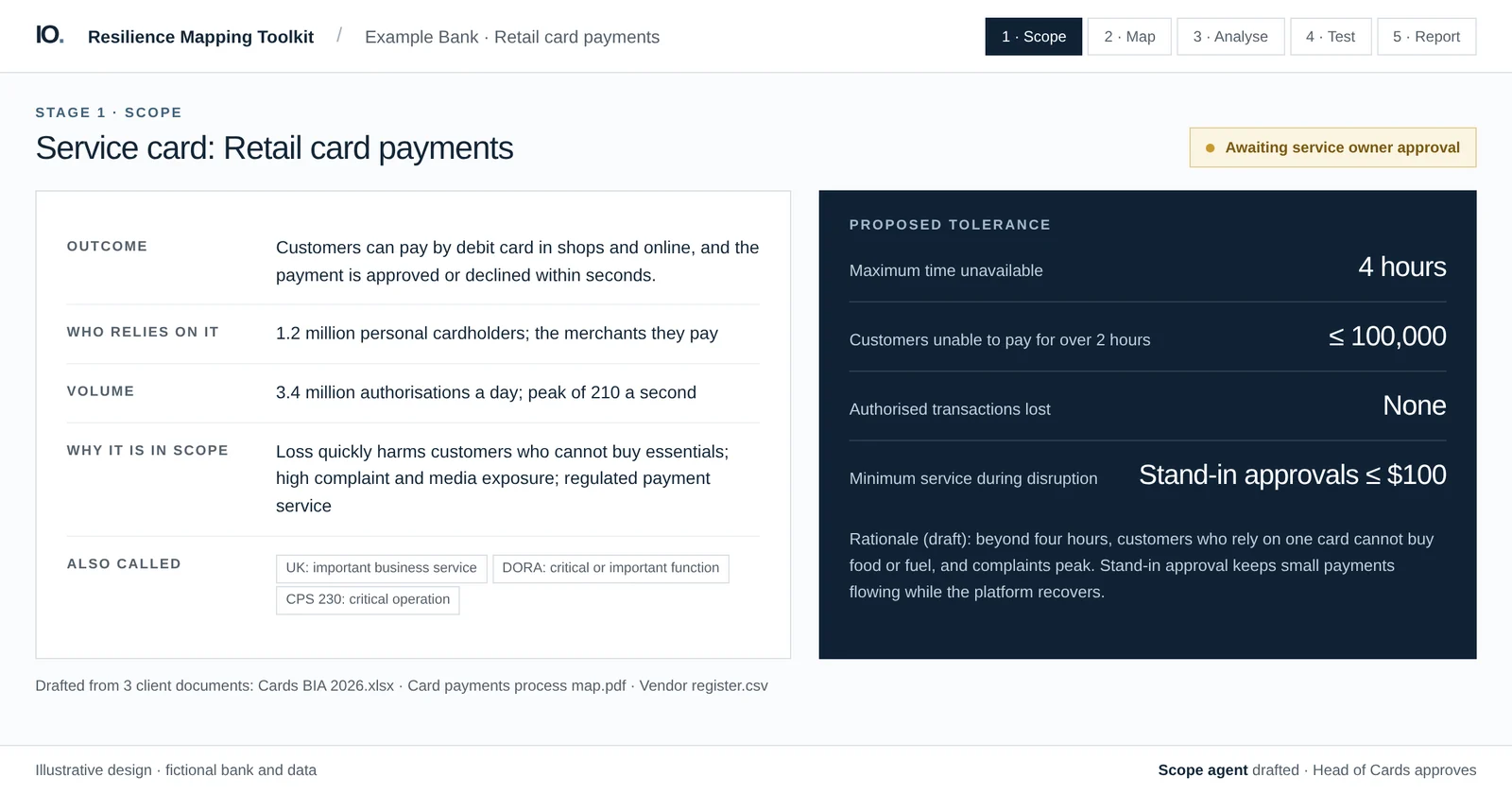
    The scope agent drafts a one-page service card from a short description or existing documents: the customer outcome, who relies on it, volumes, and a proposed tolerance with its rationale.

    PERSON DECIDESService owner approves the tolerance

  2. STAGE 2 · MAP

    Map what the service depends on

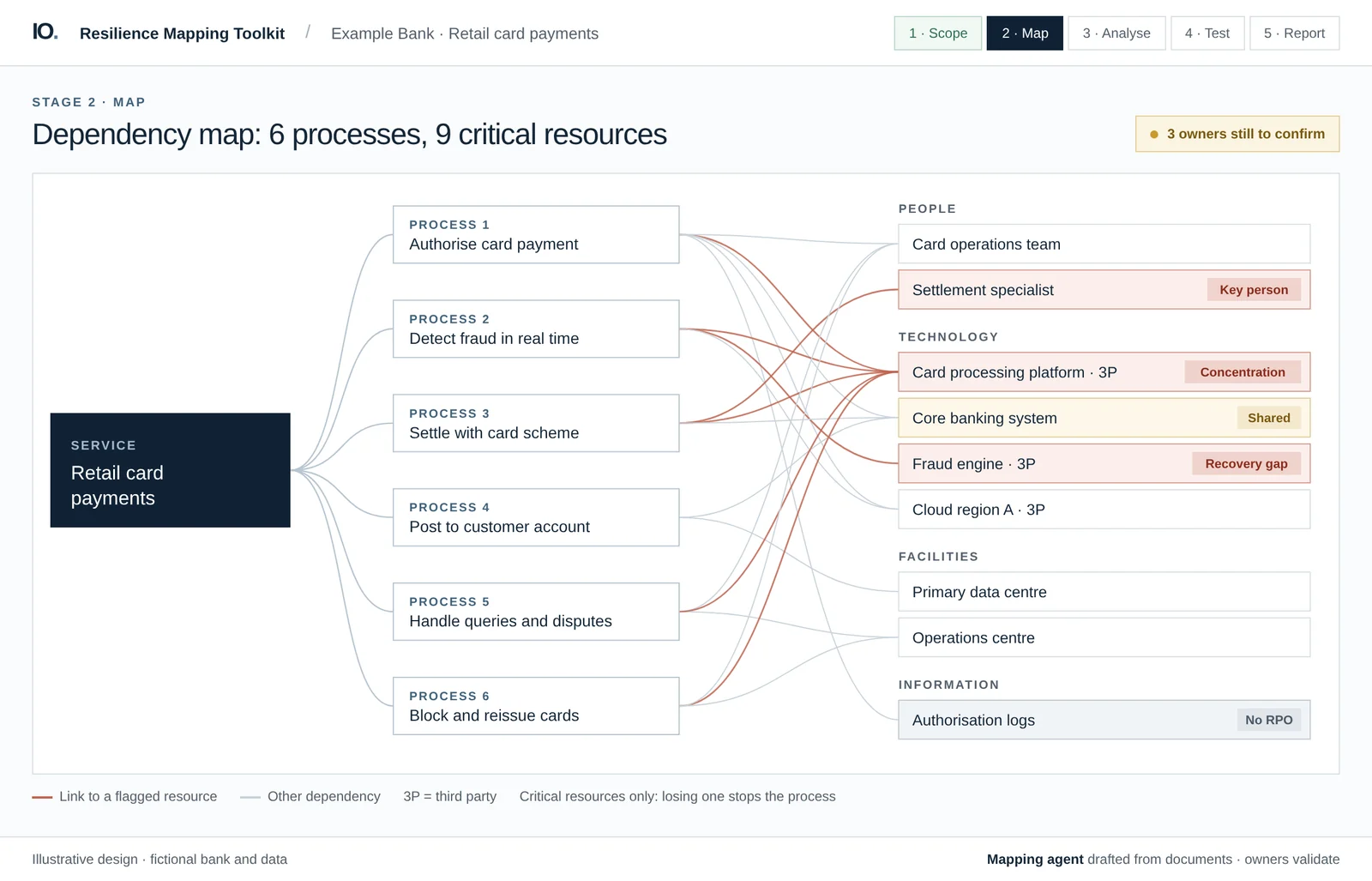
    The mapping agent reads process documents, system inventories, the vendor register and any business impact analysis, then drafts processes and their critical resources. It lists the gaps and writes a short question set for each owner.

    PERSON DECIDESProcess and resource owners confirm the map

  3. STAGE 3 · ANALYSE

    Find the weak points

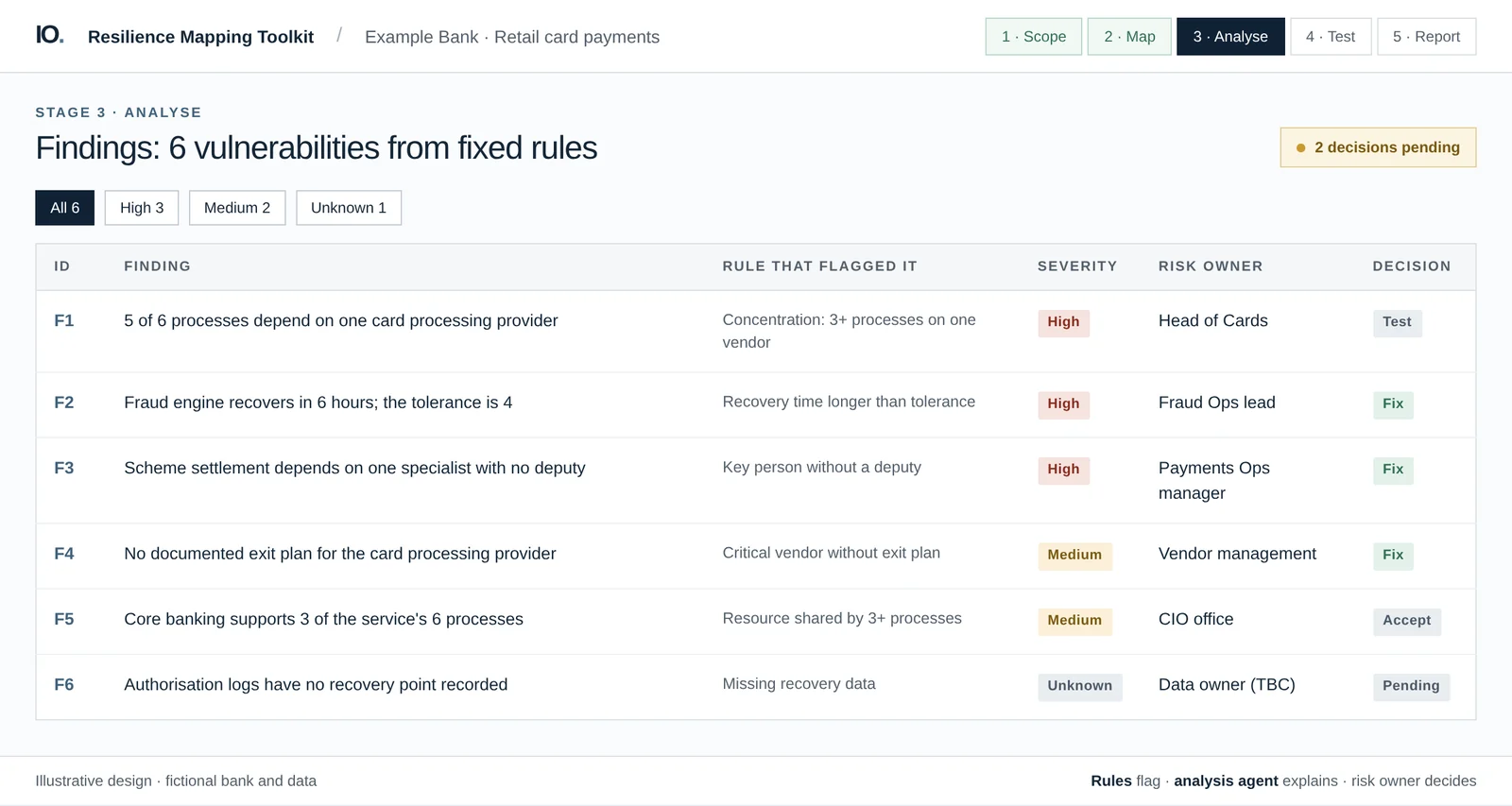
    Fixed rules flag single points of failure, concentration, key people, recovery gaps and vendors without exit plans. The analysis agent explains each finding in plain language.

    PERSON DECIDESRisk owner decides: fix, accept or test

  4. STAGE 4 · TEST

    Test against the tolerance

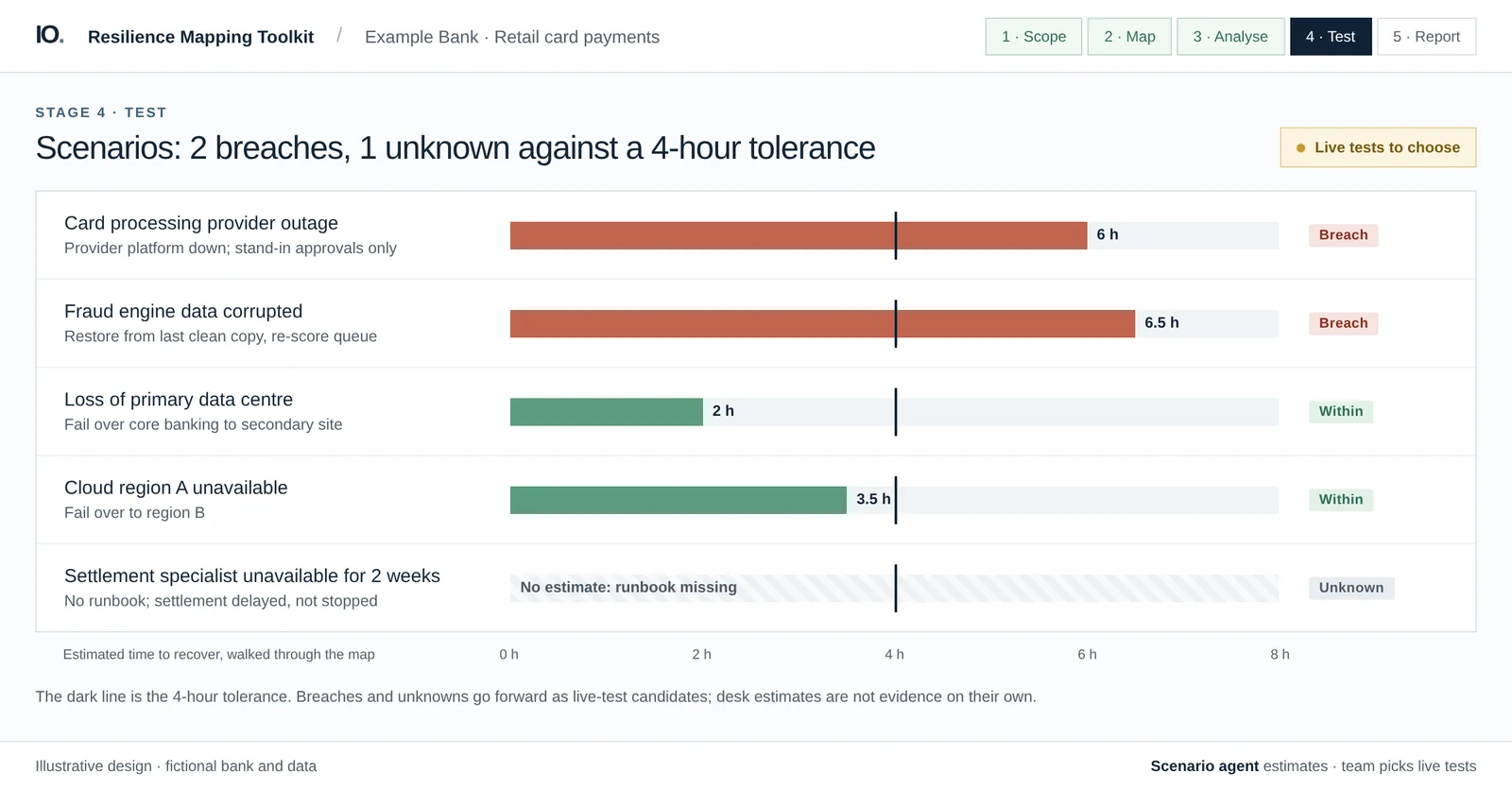
    The scenario agent writes severe-but-plausible scenarios aimed at the findings and walks the map to estimate within tolerance, breach or unknown.

    PERSON DECIDESTeam chooses which to run as live tests

  5. STAGE 5 · REPORT

    Report and keep it current

    The report agent drafts the self-assessment section, the vulnerability register and the remediation plan. A change to a process, system or vendor re-runs stages 2 to 4 for the affected services.

    PERSON DECIDESBoard approves, annually or on change

DESIGN PREVIEW

What a consultant and client see.

Screens from the intended design, shown for a fictional bank’s retail card payments service.

RULES, NOT JUDGMENT

Seven rules find the weak points.

Fixed rules keep findings consistent and defensible. Thresholds are starting points, tuned with each client.

No alternate

A critical resource with no backup, substitute or workaround.

Shared resource

One resource supports three or more of the service’s processes.

Concentration

Three or more processes depend on the same vendor, site or cloud region.

Key person

A person or small team the service needs, with no trained deputy.

Recovery gap

A resource’s recovery time, or data loss, exceeds the service’s tolerance.

Vendor without an exit

A critical third party with no exit plan or tested continuity plan.

Unknowns

Anything with no owner or no recovery data. Unknown is a finding, not a pass.

ONE VOCABULARY

Plain terms, every regime.

The toolkit works in three plain terms and translates its outputs into each regulator’s language.

TOOLKITUK PRA / FCAEU DORAAPRA CPS 230BASEL / US INTERAGENCY
ServiceImportant business serviceCritical or important functionCritical operationCritical operation; core business line (US)
ToleranceImpact toleranceRecovery time and recovery point objectivesTolerance levels: disruption period, data loss, minimum serviceTolerance for disruption
MapPeople, processes, technology, facilities, informationInformation and ICT assets, ICT third-party providersPeople, technology, information, facilities, service providersInterconnections and interdependencies

Grounded in: PRA SS1/21 · FCA observations · DORA Article 8 · APRA CPS 230 · Basel principles · US interagency paper

WHERE IT STANDS

Designed. Building next.

The toolkit is being built in the open; this page updates as each stage lands.

  1. Done

    Method and design

    Research across the main regimes, the five-stage workflow, the fixed rules and the screens on this page.

  2. Next

    Scope and mapping skills

    Build stages 1 and 2 as skills in a Claude Project, with the working-file template, and run them end to end on a fictional service.

  3. Then

    Analysis, scenarios and reporting

    Build stages 3 to 5, tune the rule thresholds on the pilot, and prepare a client pilot.

Want to pilot it?

I’m looking for a small number of firms to map one important service with me as the toolkit is built.