JUNTERO LABS
Framework design and working prototype
A risk and control framework for generative and agentic AI, with a console that runs it
I designed the Juntero Agentic Technology Controls Framework (JATCF): eight coordinated standards that take an AI use case from intake to an approved, documented governance decision. Then I built a browser console that walks an assessment through every stage, with a draft at each step and a named reviewer signing off.
The live console opens in Claude and runs on your own Claude account. The demo uses a rules engine instead of AI.
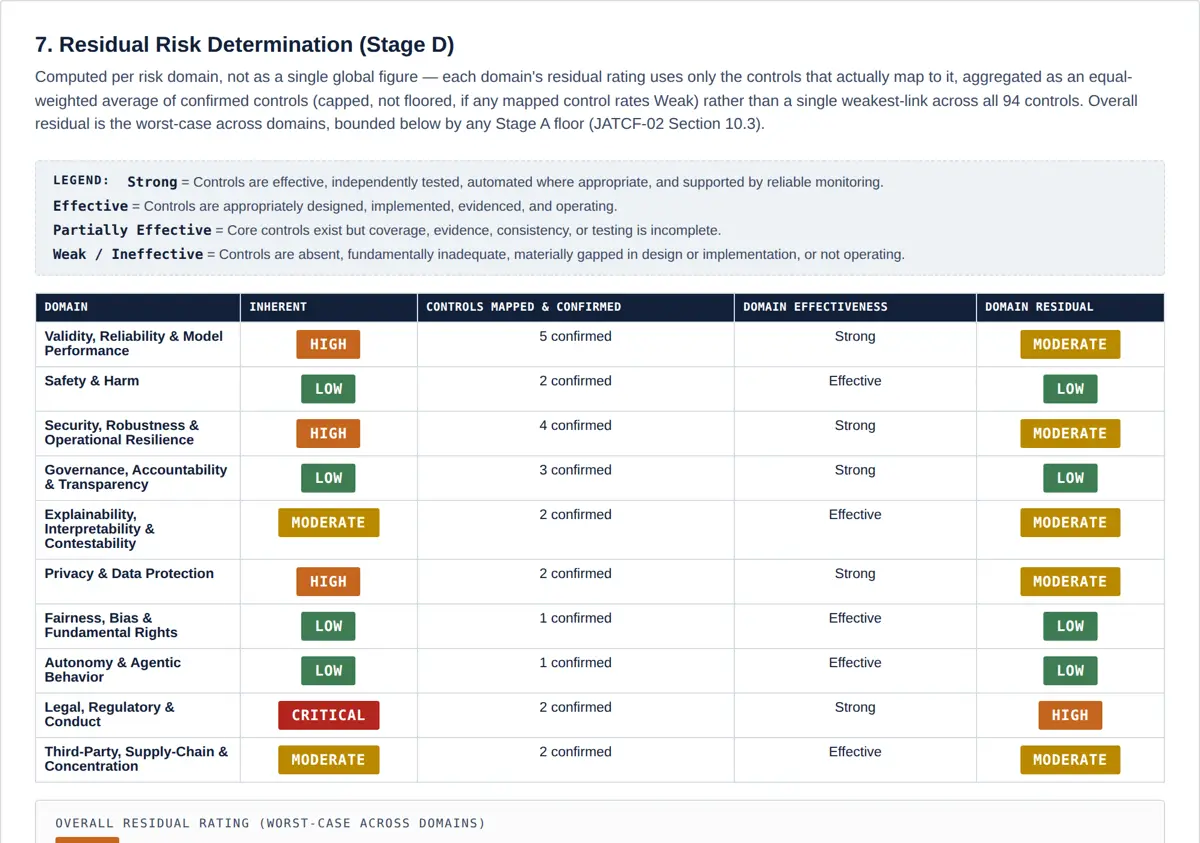
Residual risk, domain by domain
Result from the console for a sample use case: a client-email drafting assistant.
Overall residual: High, set by the worst domain, not the average.
The problem
Many AI governance programs score a use case once, apply a control percentage, and land on a single number. That number hides where the risk actually sits. A tool can have excellent security controls and still carry serious legal exposure, and a blended score averages the two away.
Agentic systems make this harder. Once a model can take actions rather than only produce text, who approves it depends on how much autonomy it has, not only on how risky its outputs are.
The approach
JATCF treats AI risk as an extension of existing technology, data, cyber and third-party risk disciplines rather than a parallel function. Every use case is scored across ten risk domains, matched against 94 controls in 14 families, and given a residual rating per domain.
It runs on tools most enterprises already own. The implementation standard maps every register and workflow onto SharePoint and Power Automate, with no custom database.
How an assessment moves
Four stages, kept separate so that classification, raw exposure, control quality and the final rating can't contaminate one another.
Classification
Regulatory and use-case screening, including EU AI Act tiers. Prohibited uses stop here; others pick up mandatory risk floors.
Inherent risk
Likelihood × impact for each of the ten domains, scored as if no controls existed. Impact takes the worst credible dimension, not an average.
Control match
Controls apply by risk tier or feature trigger. Each is rated for effectiveness, then rolled up only to the domains it mitigates.
Residual risk
A calibrated matrix crosses each domain's inherent rating with its control effectiveness. The worst domain sets the overall rating.
The result routes to the right approval tier, produces a draft executive report, and creates a governance record with monitoring, key risk indicators and a reassessment date.
Design decisions I'd defend
No residual-risk formula
Inherent × (1 − effectiveness) implies a precision that control testing can't support. A qualitative matrix is more honest and easier to challenge in committee.
Critical stays at least High
A domain with critical consequence potential never drops below High residual, however strong its controls look. Severity doesn't disappear because mitigation is good.
One weak control caps a domain
Effectiveness is averaged across a domain's controls, but any ineffective control caps that domain at Partially Effective. An earlier weakest-link rule overstated risk, so I replaced it.
Autonomy carries its own weight
Five autonomy levels, from output-only to multi-agent delegation. Each level locks in its mandatory safeguards, Level 3 must be shown to the top council, and Level 4 needs its approval whatever the scores say.
Approval and acceptance use different ratings
Who approves is keyed to inherent risk, so senior reviewers see genuine exposure. Formal risk acceptance is keyed to residual risk, which is what the organization actually keeps.
AI drafts, people decide
In the live console, Claude drafts the scores, works through the control catalogue with lookup tools, and writes the report. Fixed JATCF rules then check each draft: they lift any score below a rules floor, add mandatory safeguards it missed and discard control IDs that don't exist. A named reviewer validates or overrides every step, and any change from the draft needs a written reason.
What the console produces
Stage D for the sample use case. Each domain is paired only with the controls mapped to it, so strong data controls can't hide a legal exposure.
The document suite
Eight standards under one management-system umbrella, JATCF-00, versioned together with two methodology appendices. A change to the taxonomy or control catalog in one triggers a consistency review of the rest. Browse all the documents in Google Drive
| Doc | Title | What it settles |
|---|---|---|
| JATCF-00 | AI Risk Management System Standard | The management-system umbrella: how the other eight are owned, reviewed and kept consistent |
| JATCF-01 | AI Governance Charter | Authority, tiered decision rights, escalation and lines of defense |
| JATCF-02 | AI Risk Assessment Methodology | Ten-domain taxonomy, the four stages, per-domain residual risk |
| JATCF-03 | AI Control Standard | 94 controls in 14 families, mapped to the domains they mitigate |
| JATCF-04 | AI System Assessment Questionnaire | Intake questions that mirror the console |
| JATCF-05 | AI Control Assessment Workbook | Design and operating-effectiveness testing, domain roll-up |
| JATCF-06 | Agentic AI Standard | Autonomy levels, agent safeguards, OWASP Agentic Top 10 crosswalk |
| JATCF-07 | AI Monitoring and Incident Standard | Key risk indicators, incident severity, escalation and reporting |
| JATCF-08 | SharePoint Information Architecture | Fifteen registers and libraries plus Power Automate flows |
Run an assessment yourself
The console takes one use case through all ten steps, from intake to governance record. Describe a real or invented AI tool and watch Claude reason through it, step by step, under the framework's rules.
The live console opens in Claude and uses your own Claude account. Your first AI step asks your permission, usage counts toward your Claude plan, and nothing you enter is sent to me. The demo runs entirely in your browser with rules-based drafts. Neither stores what you enter.
- Start from one of three built-in examples, or describe your own tool. A full run takes ten to fifteen minutes with Claude.
- Open the trace under each draft: Claude's reading of your use case, each control family it looks up, and every adjustment the JATCF rules make.
- Set an agentic use case to autonomy Level 3 or 4 to see safeguards lock in and approval escalate.
- Override one of Claude's draft scores and watch the residual rating follow.
- In the invoice-agent example, one weak safeguard keeps the autonomy domain at Critical. Fix its rating and see what changes.